
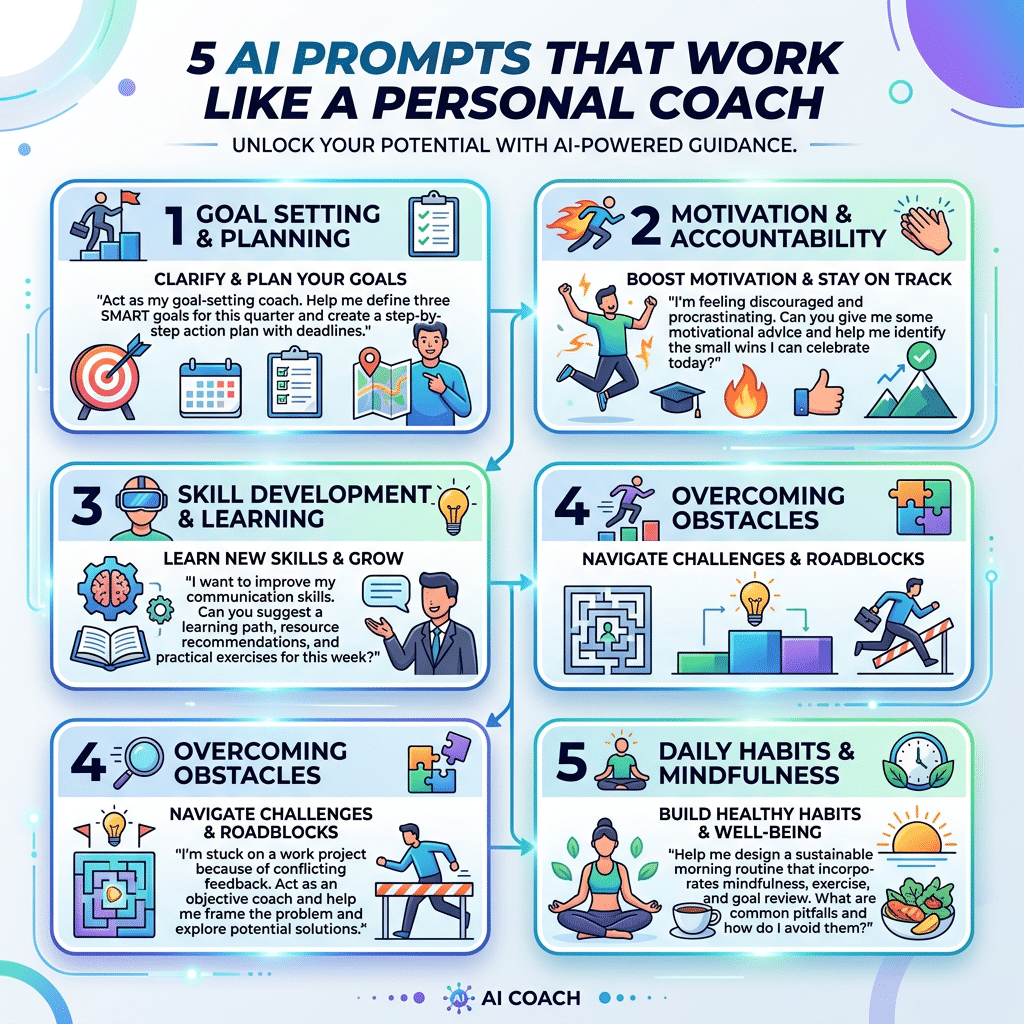
5 AI Prompts That Work Like a Personal Coach (2026) are designed to help you achieve your goals with the support of artificial intelligence, as if you had your own personal coaching session.
A good coach does three things: asks the right questions, holds you accountable, and helps you see what you can’t see on your own. A one-on-one coach can cost hundreds of dollars a month.
An AI assistant can’t fully replace a human coach. But with the right prompts, it can do a surprising amount of that work for free, any time of day.
You’re not alone if you’ve already tried it. AI has become the world’s most-used coach and therapist, and it’s one of the forces reshaping the $51 billion self-improvement industry in 2026 (b-e-t-t-e-r.com). AI-powered personal coaching is also one of the top personal growth trends of the year (InspireFusion).
The difference between a useless AI answer and a helpful one comes down to the prompt. Below are five copy-and-paste prompts that turn any AI chat tool, like ChatGPT, Claude, Gemini, or Perplexity, into a personal coach.

How to Get the Most Out of These Prompts
Before you start, keep these three rules in mind:
- Be honest and specific. The more real detail you give, the better the coaching. “I want to get fit” gets a generic answer. “I’m 42, I sit at a desk all day, and I’ve quit the gym three times” gets a real plan.
- Let it ask questions. Each prompt below tells the AI to ask you questions first. Answer them. That’s where the coaching happens.
- Keep one ongoing chat. Use the same conversation (or a saved project) each week so the AI remembers your goals and progress.
Copy any prompt, replace the text in [brackets], and paste it into your AI tool.
Prompt 1: The Goal-Setting Coach
Most goals fail because they’re vague. This prompt turns a fuzzy wish into a clear goal with a plan behind it.
textAct as an experienced personal coach. I want to work on this goal: [describe your goal].

Before giving advice, ask me 5 questions, one at a time, to understand my situation, my
motivation, what has stopped me before, and how much time I realistically have.

After I answer, help me:
1. Turn my goal into one specific, measurable 90-day goal
2. Explain why this goal matters to me in one sentence, using my own words
3. Break it into 3 monthly milestones
4. Give me one small daily or weekly habit to start this week
5. Predict the 2 most likely obstacles I'll face and how to handle each

Be direct and honest. If my goal seems unrealistic, tell me.
Why it works: The questions force you to think before you plan. The “most likely obstacles” step is what most goal-setting skips, and it’s often why goals fall apart.
Prompt 2: The Daily Journaling Coach
Staring at a blank journal page is hard. This prompt gives you a guided five-minute reflection that actually goes somewhere.
textBe my journaling coach. Guide me through a 5-minute evening reflection.

Ask me these questions one at a time, and wait for my answer before moving on:
1. What is one thing that went well today, and why?
2. What drained my energy today?
3. What did I avoid, and what was I afraid of?
4. What is one thing I'm grateful for?
5. What is the one most important thing I'll do tomorrow?

After my last answer, give me a short summary of what you noticed, including any
pattern or thought worth paying attention to. Keep it kind but honest.
Why it works: Question 3 is the powerful one. Avoidance usually points straight at what matters most. Over time, the summaries help you spot patterns in your mood and energy.
Tip: Once a week, ask the AI: “Based on my journal entries this week, what patterns do you notice?”
Prompt 3: The Weekly Planning Coach
Sunday planning is one of the highest-value habits you can build. This prompt helps you plan a realistic week instead of an overloaded one.
textAct as my weekly planning coach. Help me plan the week of [date].

Here's my situation:
- My top goals right now: [list 1–3 goals]
- Fixed commitments this week (work, appointments, family): [list them]
- Hours I realistically have for my own goals: [number]
- What I didn't finish last week: [list or "none"]

Please:
1. Help me choose my top 3 priorities for the week. Push back if I'm trying to do too much.
2. Suggest which days and times to work on each priority based on my schedule.
3. Identify anything I should drop, delay, or delegate.
4. Give me one "minimum win" for each day, the smallest action that still counts as progress.

Present the final plan as a simple day-by-day list.
Why it works: Asking the AI to push back keeps you from planning a fantasy week. The “minimum win” for each day keeps you moving even when the week goes sideways.
Prompt 4: The Accountability Check-In
A coach’s real value is the follow-up. This prompt recreates the weekly check-in that keeps you honest.
textYou are my accountability coach. Here's my weekly check-in.

My goals and plan for last week: [paste last week's plan or goals]
What I actually did: [be honest]
How I felt about it, from 1 to 10: [number]

Please:
1. Give me an honest assessment of my week. Don't sugarcoat it, but don't be harsh.
2. Point out what worked so I can repeat it.
3. Help me figure out the real reason I missed anything I missed.
4. Suggest one adjustment for next week, either making a habit easier or changing when I do it.
5. Ask me one tough question to think about this week.
Why it works: Step 3 matters most. Missing a goal is rarely about laziness. Usually the habit was too big, badly timed, or not tied to something you care about. This prompt helps you find the actual cause.
Tip: Use Prompt 4 and Prompt 3 together every Sunday. Check in on last week, then plan the next one.
Prompt 5: The Mindset Reset Coach
Some days the problem isn’t your plan. It’s your head. Use this prompt when you feel stuck, overwhelmed, or ready to quit.
textAct as a supportive but practical mindset coach. I'm feeling [stuck / overwhelmed /
unmotivated / doubtful] about [situation].

Here's what's going on: [describe it in a few sentences].

Please:
1. Help me separate the facts of my situation from the story I'm telling myself about it.
2. Ask me 2 questions that help me see the situation differently.
3. Remind me of what's actually in my control right now.
4. Give me one small action I can take in the next 30 minutes to get moving again.

Keep your response short and grounded. No generic motivational quotes.
Why it works: Separating facts from stories is a classic coaching technique. And ending with a 30-minute action breaks the spiral of overthinking.
Build a Simple Weekly Coaching Routine
Here’s how to put all five prompts together without it taking over your life:
| When | Prompt | Time |
|---|---|---|
| Once, then every 90 days | Prompt 1: Goal-Setting Coach | 20 minutes |
| Every evening | Prompt 2: Journaling Coach | 5 minutes |
| Sunday | Prompt 4: Accountability Check-In | 10 minutes |
| Sunday | Prompt 3: Weekly Planning Coach | 15 minutes |
| As needed | Prompt 5: Mindset Reset Coach | 5 minutes |
5 AI Prompts That Work Like a Personal Coach (2026)
That’s about an hour a week for structured, personalized coaching.
Doing the Winter Arc? These prompts pair well with a 60-day challenge. Use Prompt 1 to pick your three focus areas, then run Prompts 3 and 4 every Sunday until December 31. (Link to your Winter Arc post here.)
A Few Important Limits
AI coaching works well for goals, habits, planning, and reflection. But keep a few things in mind:
- It’s not therapy. If you’re dealing with depression, anxiety, trauma, or a crisis, talk to a licensed mental health professional. In the U.S., you can call or text 988 to reach the Suicide & Crisis Lifeline any time.
- Watch what you share. Avoid putting passwords, financial account details, or very private information into AI chats.
- You still have to do the work. The best plan in the world won’t help if it stays in the chat window.
The Bottom Line
You don’t need an expensive coach to start growing. You need good questions, honest answers, and a regular check-in, and the right AI prompts can give you all three.
Pick one prompt from this list and try it tonight. The journaling coach (Prompt 2) is the easiest place to start.
Which prompt are you trying first? Let me know in the comments.
Sources
- b-e-t-t-e-r.com, “The State of Self-Improvement in 2026: 40+ Statistics & Trends” — https://b-e-t-t-e-r.com/blog/the-state-of-self-improvement/
- InspireFusion, “12 Motivation Trends Defining Personal Growth 2026” — https://www.inspirefusion.com/motivation-trends-personal-growth-2026/




Leave a Reply