
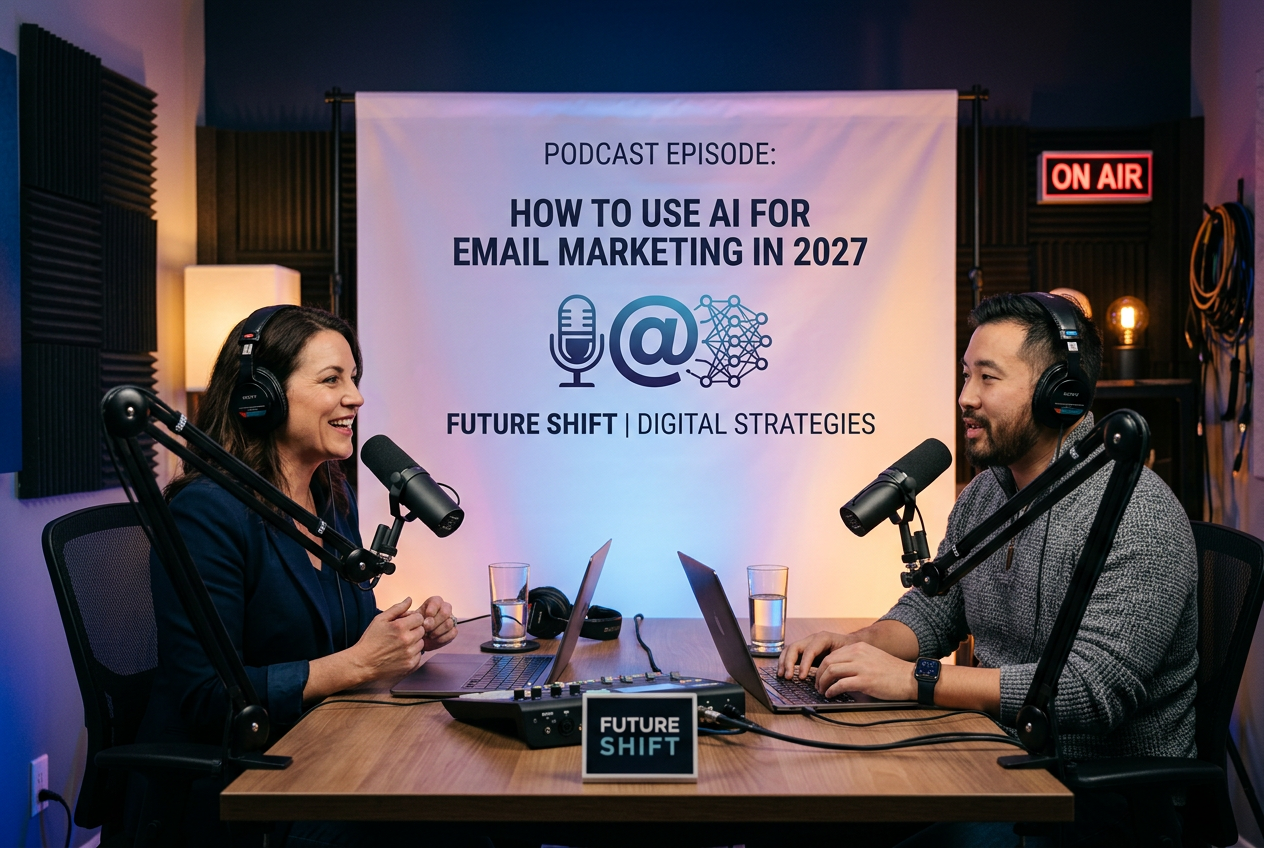
Pip: Email marketing: the channel that refuses to die, keeps printing money, and is now apparently getting a robot co-pilot. Welcome to rtate blog, where rtateblogspot has been doing the research so you don’t have to. In this Podcast Episode: How to Use AI for Email Marketing in 2027, we’ll break down the latest insights.
Mara: Today we’re covering how AI is reshaping email marketing — the real numbers, the practical workflows, and where the whole thing can quietly go wrong. Let’s start with what AI actually does inside an email program. This is especially relevant as discussed in Podcast Episode: How to Use AI for Email Marketing in 2027.
How AI Is Reshaping Email Marketing
Mara: The framing question here is whether AI in email is a genuine performance lever or just a shinier version of the tools marketers already ignore. The post makes a direct case that it’s the former. In the context of a podcast episode discussing how to use AI for email marketing in 2027, these questions are crucial. Moreover, they matter for decision-makers.
Pip: And it leads with the number that earns that claim: “advanced AI adopters are 75% more likely to report email ROI above 45:1 than early-stage teams.”
Mara: That’s from Litmus State of Email 2026, and it sits on top of a baseline that’s already strong — email returns thirty-six to forty-two dollars for every dollar spent before AI enters the picture. In other words, the gap between adopters and everyone else is the story.
Pip: So what does AI actually do to move that number? The post breaks it into five areas. The first one is the most immediate: subject lines. AI-generated variants have shown open-rate lifts of up to twenty-two percent. For example, typical gains are five to ten percent over manual ones. In case you want more strategies, remember the Podcast Episode: How to Use AI for Email Marketing in 2027 dives deeper into practical tactics like these.
Mara: The practical workflow is specific — generate ten to fifteen variants in different tones, and A/B test the top two with at least a thousand recipients per variant. Then feed the winner back into your prompt examples. This way, the tool learns your voice. Below that thousand-recipient threshold, the post notes, you get noise, not signal.
Pip: Personalization is where the numbers get almost uncomfortable. AI-powered personalization lifts click-through rates by about forty-one percent. Moreover, segmented campaigns outperform non-segmented sends by seven hundred sixty percent in revenue. That last figure is the kind of stat that makes you wonder what you’ve been doing.
How AI Is Reshaping Email Marketing
Mara: The post is careful to distinguish real personalization from first-name tokens. It means AI deciding which products, offers, and content each subscriber sees based on behavior. In fact, a solo marketer with Klaviyo or Mailchimp can now do this without a data team. It’s exciting to see, as Podcast Episode: How to Use AI for Email Marketing in 2027 makes clear. These tools are becoming accessible even for lean teams.
Pip: Automated flows are the third lever, and the benchmark here is striking. Klaviyo’s data across a hundred and eighty-three thousand brands found that automated flows generate about forty-one percent of total email revenue from just five percent of send volume. With these automation figures, you can appreciate the kind of future Podcast Episode: How to Use AI for Email Marketing in 2027 envisions for email professionals.
Mara: Send-time optimization and predictive analytics round out the five. Send-time optimization alone is linked to revenue increases of about forty-one percent, and it’s usually a single toggle inside your existing ESP. The post also flags where this breaks down — AI still hallucinates product details and prices. Additionally, eighty-one percent of marketers say disjointed data holds back their AI results.
Pip: The mistake section is honest in a way that’s easy to miss: seventy-three percent of marketers use generative AI for email, but only eighteen percent trust its output. That fifty-five-point gap is the real implementation problem, not the tools. In a Podcast Episode focused on how to use AI for email marketing in 2027, it’s clear trust and effective use are key themes.
How AI Is Reshaping Email Marketing
Mara: The post’s answer is a thirty-day starter plan — send-time optimization in week one, subject line testing in week two, one automated flow in week three, and a campaign analysis in week four. In other words, four AI touchpoints, and no new tools are required.
Pip: The through-line here is that the performance gap is already opening — and it’s being driven by people who treat AI as infrastructure, not as a novelty. So, Podcast Episode: How to Use AI for Email Marketing in 2027 suggests taking a proactive stance to stay ahead.
Mara: The data backs that up. Better subject lines, personalization lifts, automated revenue, and a cleaner path to ROI that compounds. Undoubtedly, Podcast Episode: How to Use AI for Email Marketing in 2027 will be essential listening for marketers eager for the latest strategies. It is worth watching how this looks a year from now.





Leave a Reply