
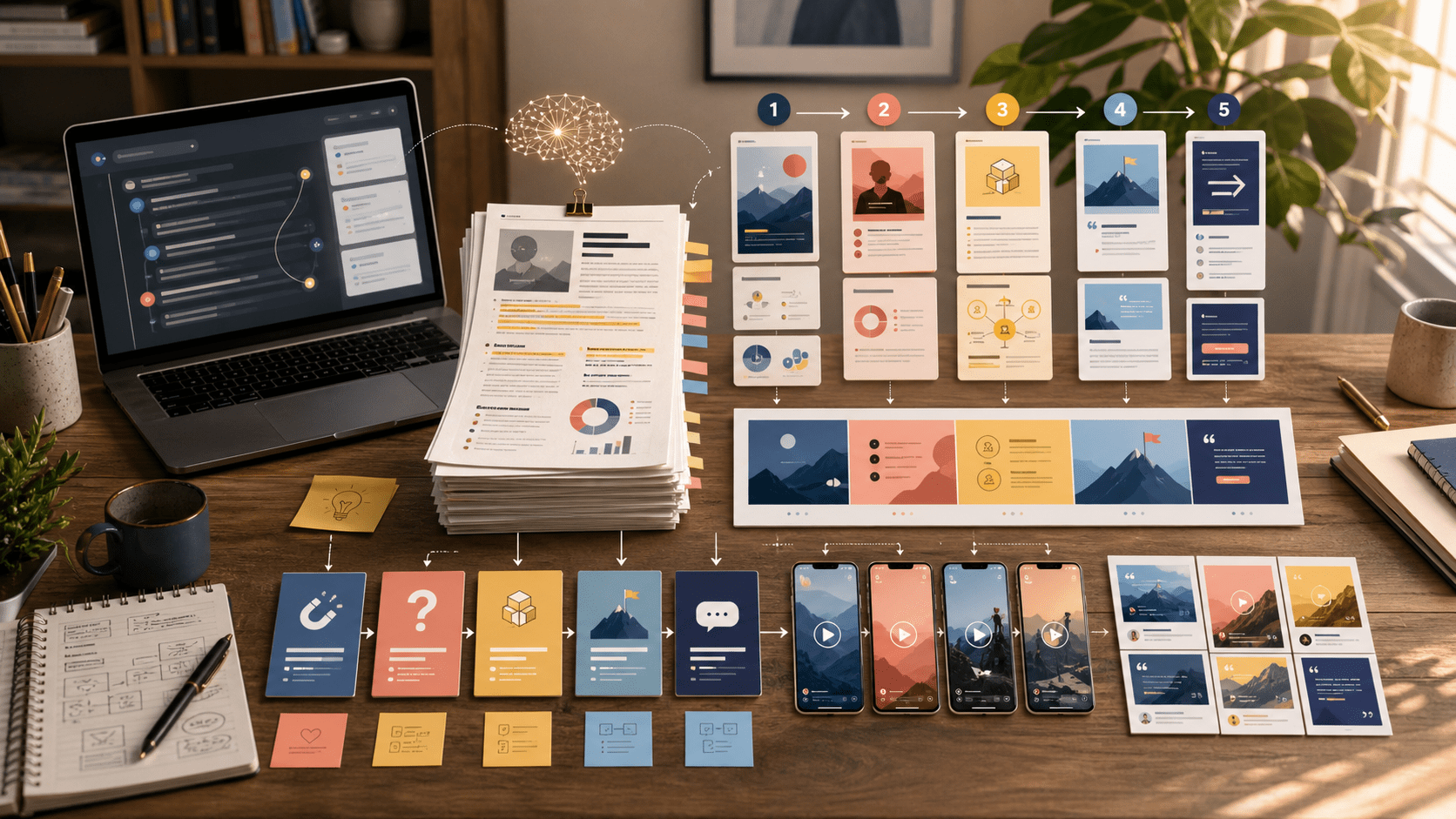
Lesson 11: Repurposing Articles into Social Media Series explores how repurposing a long-form article into a social media series involves defining a goal, identifying reusable sections, and arranging ideas into a logical sequence. Articles can be adapted into threads, carousels, and short-form video scripts, with each format tailored to its platform.
AI can help outline, draft, and polish posts, while human review preserves accuracy, voice, and consistency.
Lesson 11: Repurposing Articles into Social Media Series
Long-form articles are goldmines for social media content. Instead of posting a single generic promo, you can turn one article into a focused, multi-post series that builds curiosity, reinforces key ideas, and saves you time. In this lesson, you will learn how to break an article into a series, choose the best content chunks, adapt them for different platforms, and use AI to speed up the process.
Step 1: Define the Purpose of the Series
Before you start slicing up your article, decide what the series should achieve. Common goals include teaching a mini-framework, teasing a longer piece of content, building authority on a topic, or driving traffic back to your website. A clear goal helps you decide what to keep, cut, or combine.
Step 2: Identify Natural “Chunks” in Your Article
Most articles already have a built-in structure you can use. Look for:
- Sections and subheadings — each can become its own post.
- Lists and bullet points — each item can be expanded into a standalone post.
- Stories, examples, or case studies — ideal for engaging posts with a narrative hook.
- Statistics, quotes, or definitions — great for short, high-impact posts.
As you scan the article, highlight 3–7 core ideas. These will likely become the posts in your series.
Step 3: Map Your Ideas into a Logical Sequence
Your series should feel like a journey, not a random set of posts. A simple structure you can use is: hook → problem → framework → examples → call to action. Each post should stand on its own but also make people want the next one.
Step 4: Format for Different Platforms
Once you know your core posts, adapt them to fit each platform’s strengths.
- Threads (X/LinkedIn): Use one key idea per post in the thread. Start with a strong hook, then break your article into short, skimmable statements. Aim for 1–2 sentences per tweet/update.
- Carousels (Instagram/LinkedIn): Turn each main point into a slide. Slide 1: hook. Middle slides: 1 idea each with a short line of text. Final slide: summary + call to action.
- Reels/Shorts scripts: Condense each post into a 15–45 second script. Use a pattern like: hook → one key point → quick example → call to action.
Step 5: Use AI to Repurpose Efficiently
You can feed your article into an AI tool and ask it to suggest a series outline and draft posts. Here are sample prompts you can adapt:
- For outline: “Here is a blog post about [topic]. Turn it into a 5-part social media series. For each post, give me: a working title, 1–2 sentence summary, and the main takeaway.”
- For platform versions: “Using this article and this 5-part outline, write: (a) an X thread with 7–10 posts, (b) copy for a 7-slide Instagram carousel, and (c) a 30-second Reels script for each part.”
- For polishing: “Rewrite this post for [platform] in a [professional but approachable] tone. Make the hook more compelling and keep it under [character/word] limit.”
Example: From Article to 5-Post Series
Imagine you have an article titled: “5 Simple Steps to Improve Your Writing Productivity.” Here is how you might turn it into a 5-post LinkedIn or Instagram series:
- Post 1 – Hook + Problem: “Why most creators struggle to write consistently.” Share a short story or stat about inconsistent output and tease that you will share 5 simple steps in this series.
- Post 2 – Step 1: Plan Your Week: Turn the article’s planning section into a post on creating a simple content calendar, with 2–3 practical tips.
- Post 3 – Step 2: Create Writing Rituals: Focus on environment, time of day, and cues that signal “writing mode.”
- Post 4 – Steps 3–4: Draft Faster and Edit Later: Combine two related steps into one post, contrasting “drafting brain” vs. “editing brain.”
- Post 5 – Step 5 + Call to Action: Share the final step (e.g., tracking progress) and invite people to read the full article or download a checklist.
You could then ask AI: “Using this 5-post outline, write LinkedIn post copy for each one (max 200 words each), with strong hooks and a consistent voice.”
Key Takeaways
- Think of your article as a series of small stories and ideas, not a single unit.
- Use your existing structure — headings, lists, and examples — to define potential posts.
- Adapt each post to the strengths and limits of the platform you are posting on.
- Use AI to outline, draft, and polish your series, but keep final control of voice and accuracy.





Leave a Reply