
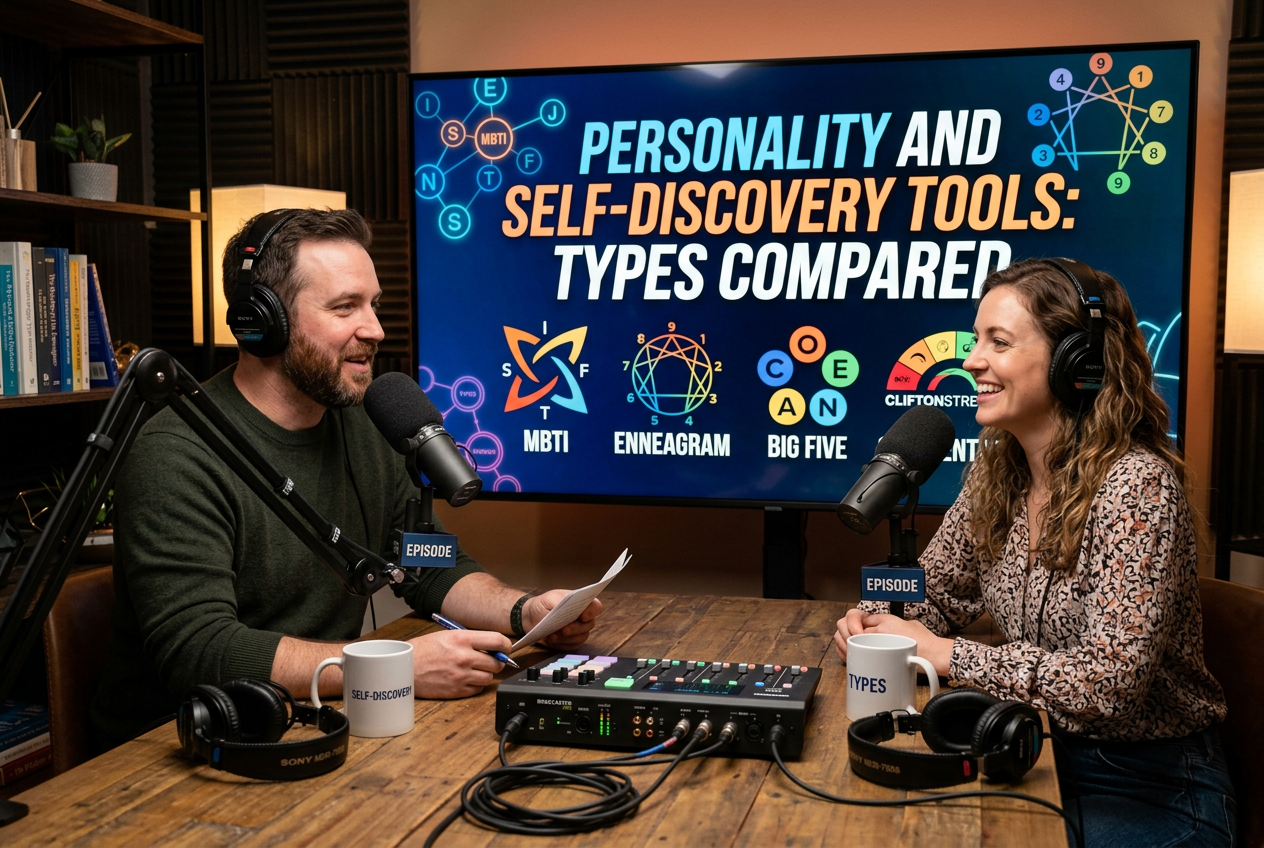
Pip: rtate blog has been asking the question that every “which Disney villain are you” quiz pretends to answer — what do these self-discovery tools actually tell you, and which ones deserve your time? In fact, these are exactly the topics we discuss in Podcast Episode: Personality and Self-Discovery Tools: Types Compared.
Mara: That’s the territory today — validated assessments versus entertainment quizzes, how to match a tool to a real question, and how to use your results once you have them. We cover all of this in Podcast Episode: Personality and Self-Discovery Tools: Types Compared.
Pip: Let’s start with the tools themselves and how to tell the good ones apart. For a deeper dive, Podcast Episode: Types Compared: Personality and Self-Discovery Tools explains these differences.

Personality and Self-Discovery Tools: What’s Worth Your Time
Mara: The core tension here lies between tools built for insight and tools built for entertainment, and the post directly explains what separates them. In our latest personality tools podcast episode, we compare types and self-discovery frameworks to help you choose.
Pip: The post puts it plainly: “Researchers build validated assessments with research methods and test them for reliability over time. Entertainment quizzes work differently. Creators design them for fun, without reliability testing, so their results may say more about your mood than your traits.”
Mara: So the upshot is that the tool’s structure determines whether you can act on the result. The post supports that point with a meta-analysis that found a moderate positive effect on self-knowledge — but only when researchers design the tool well and pair it with real follow-up. Podcast Episode: Types Compared illustrates this point as it reviews several personality and self-discovery tools in detail.
Pip: Which does a lot of work. A quiz that tells you you’re a Deborah is not the follow-up they had in mind.
Mara: Right — and the post actually addresses that. The Bible character quiz gets its own section: ten questions, ten figures, three minutes, and an explicit instruction to treat the result as a journaling prompt rather than a measurement of your traits.
Pip: The post builds a genuinely useful framework around the serious tools. It identifies four categories: personality tests, character strengths tools, values and work orientation tools, and purpose frameworks. Use one tool for each question. In case you missed it, the podcast episode compares these self-discovery tools and personality types.
Personality and Self-Discovery Tools: What’s Worth Your Time
Mara: On the personality side, the Big Five places you on continuous scales for five traits — openness, conscientiousness, extraversion, agreeableness, and neuroticism — and shows test-retest reliability above 0.75. The MBTI gives you a four-letter preference code across 16 types, and 16Personalities adds an Assertive-Turbulent dimension for 32 subtypes. The “Personality and Self-Discovery Tools: Types Compared” podcast episode compares them all in detail.
Pip: The post’s warning there deserves repetition: don’t use any letter code to make a hiring or relationship decision.
Mara: On the strengths side, the VIA Character Strengths Survey measures 24 positive strengths across six virtues. Three years of work by 55 social scientists produced it. HIGH5 covers similar ground with 120 questions and a top-five report. Notably, Episode: Personality and Self-Discovery Tools: Types Compared discusses these distinctions in depth.
Personality and Self-Discovery Tools: What’s Worth Your Time
Pip: And for career direction, Amy Wrzesniewski’s research at Yale found that workplaces split roughly into thirds across three orientations — job, career, and calling — with calling orientation linked to higher life and work satisfaction. The podcast episode offers perspective on these self-discovery tools and compares personality types for career use.
Mara: The post closes with a limits section worth sitting with: self-report bias, cultural context, and the snapshot problem. A 2023 study of 529 students found only a weak link between MBTI results and leadership practices. As Personality and Self-Discovery Tools: Types Compared ( Episode) explains, understanding these caveats matters.
Pip: The through-line across all of it: ask one question, choose one tool, and test one insight in real life by Friday. Above all, Episode: Personality and Self-Discovery Tools: Types Compared helps listeners make sense of these nuances.
Mara: That approach feels less glamorous than a 32-subtype reveal, but it proves considerably more useful.
Pip: The real argument underneath all of this is that self-knowledge requires practice, not a score. For anyone exploring types or personality frameworks, the episode on self-discovery tools compared will open your eyes.
Mara: One question, one tool, one action — that’s where the next episode picks up too, wherever the work actually starts.




Leave a Reply