
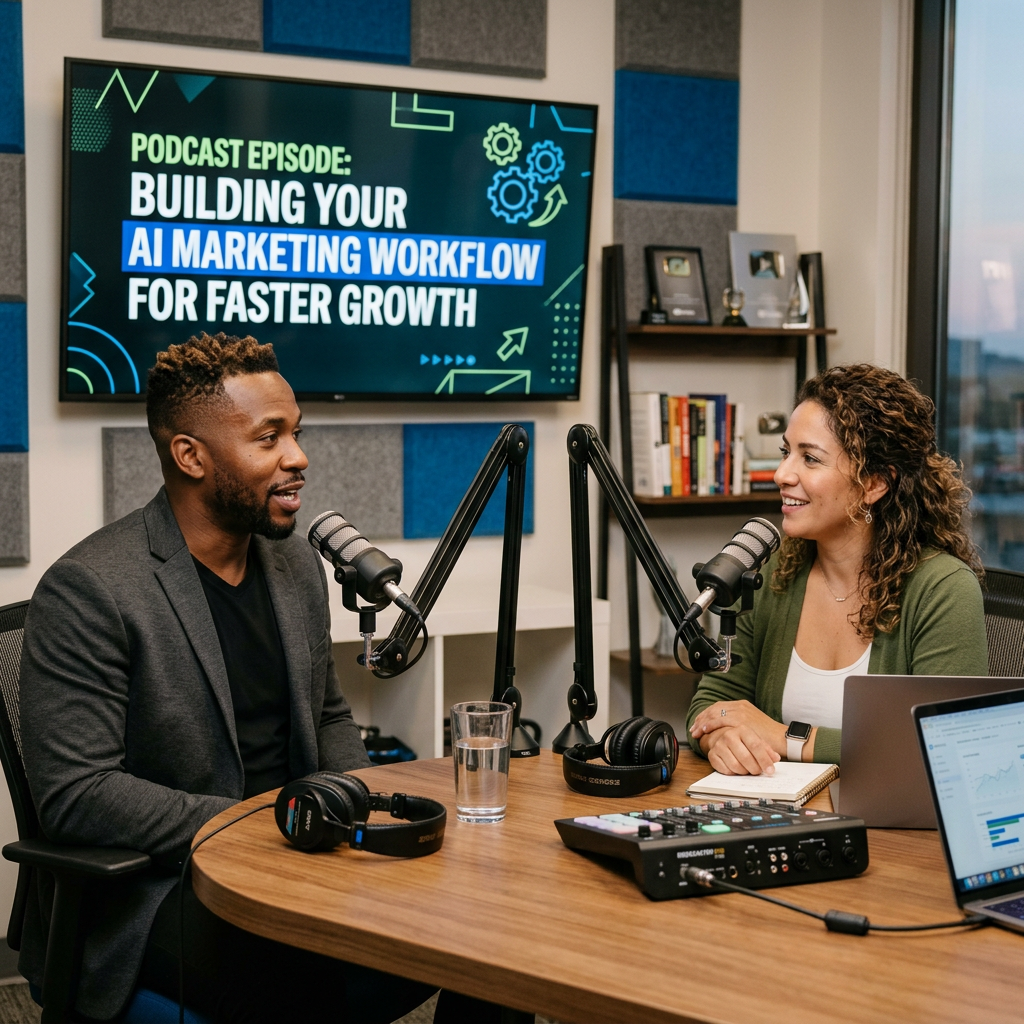
Pip: If your team is asking AI for a social post on Monday and a spreadsheet summary on Thursday, rtateblogspot has a pointed question for you. Why is the weekly report still getting downloaded by hand? In Podcast Episode: Building Your AI Marketing Workflow for Faster Growth, we discuss how to streamline these kinds of tasks for greater efficiency.
Mara: That tension — between using AI and actually redesigning how work moves — is exactly what this episode is about. We’re looking at what separates a one-off prompt from a workflow. Furthermore, we discuss how to build something your team can rely on week after week. In fact, this discussion is directly informed by Podcast Episode: Building Your AI Marketing Workflow for Faster Growth.
Pip: Let’s get into what that distinction actually costs you. By the way, everything we share today draws on lessons from the podcast episode focused on building your own AI marketing workflow to spark faster growth.
Building a Real AI Marketing Workflow
Mara: The central claim here is that most teams are using AI as an add-on, not a redesign. The post puts it plainly: “A better prompt improves one answer. A workflow improves how the work moves from start to finish. The gain comes from the whole path, not from one clever sentence.”
Pip: So the prompt is a sharper pencil, and the workflow is a different desk entirely. That gap is where most teams are losing time without knowing it. Notably, Podcast Episode: Building Your AI Marketing Workflow for Faster Growth explains these gaps in detail.
Mara: The numbers back that up. About 80 percent of marketers feel pressure to adopt AI. Yet only 6 percent have fully built it into their workflows. The old steps stay in place around the AI, so work gets faster but not different.
Pip: Faster-but-not-different is a good description of a lot of digital transformation, honestly. And as emphasized in our episode about building your ideal AI marketing workflow for greater growth, change only comes from rethinking the whole structure.
Mara: The post offers a concrete test for finding tasks worth redesigning: if the same task goes to AI three or more times in a month, it deserves a closer look. Frequency is the signal, not the rule. You also check whether the task is repetitive, time-consuming, well understood, impactful, and low risk.
Pip: That last criterion is the one teams skip. A task that sends money or messages to customers without review is not your first candidate. Also, in the spirit of the Podcast Episode on building an AI marketing workflow for rapid growth, always prioritize low-risk, repetitive actions.
Mara: Right. Once you’ve picked a candidate, the post walks through mapping the process as it actually runs — bottlenecks included — and capturing context. This includes brand rules, examples of good and bad output, decision criteria, and the judgment calls that usually live only in someone’s head. For more tips, Podcast Episode: Building Your AI Marketing Workflow for Faster Growth provides a step-by-step approach.
Pip: Because if the AI never sees those rules, you’re retyping them into every request forever.
Mara: The split between AI and human responsibility follows from that map. The post is direct: “Humans set direction, humans exercise judgment, and humans evaluate the system.” AI handles retrieval, synthesis, generation, and monitoring. People own strategy, brand judgment, and final approval — especially anything customer-facing. This division is central to the episode on building your AI marketing workflow to speed up business growth.
Mara: Building the chain itself follows a fixed order: trigger, data input, AI action, logic, output, human review, next action. The post warns against connecting more systems before the first one works. That is because each new link adds a failure point you may not be able to trace.
Pip: The testing standard is whether the new workflow beats the baseline process — not whether it runs fast. Accuracy, output quality, consistency, time saved, failure rate, and human effort required are all on the scorecard. These are lessons repeated in Podcast Episode: Building Your AI Marketing Workflow for Faster Growth because speed alone never guarantees success.
Mara: And the post flags a specific trap: polished output can hide a high failure rate. A content workflow that produces clean-looking drafts may still get facts wrong on new data. In fact, you won’t see it until you test on fresh work rather than the examples you built with. Insights from building your AI marketing workflow, as discussed in the episode, can help uncover those blind spots for faster growth.
Mara: There’s also a companion piece on generating 300 leads a day without paid ads, which extends the same logic — recurring, process-driven approaches outperform one-off tactics. This is true whether you’re managing campaigns or building an audience from scratch.
Pip: The through-line is the same: a system beats a clever move, every time. If you’re looking for a system to build your AI marketing workflow, check out the podcast episode for actionable strategies that drive faster growth.
Mara: The post closes with a practical week-one instruction: pick one repeated task, count how often it goes to AI in a month, and sketch its map on paper before Friday.
Pip: Small scope, real deadline — that’s the kind of advice that actually gets done. To wrap up, make sure you listen to our podcast on building your AI marketing workflow if you want faster team growth.
Mara: As a final note, Podcast Episode: Building Your AI Marketing Workflow for Faster Growth is a must-listen resource for any marketer looking to restructure processes for faster, smarter results.
Pip: Next time, we’ll see what that question looks like once the first workflow is already running. Stay with us.




Leave a Reply