

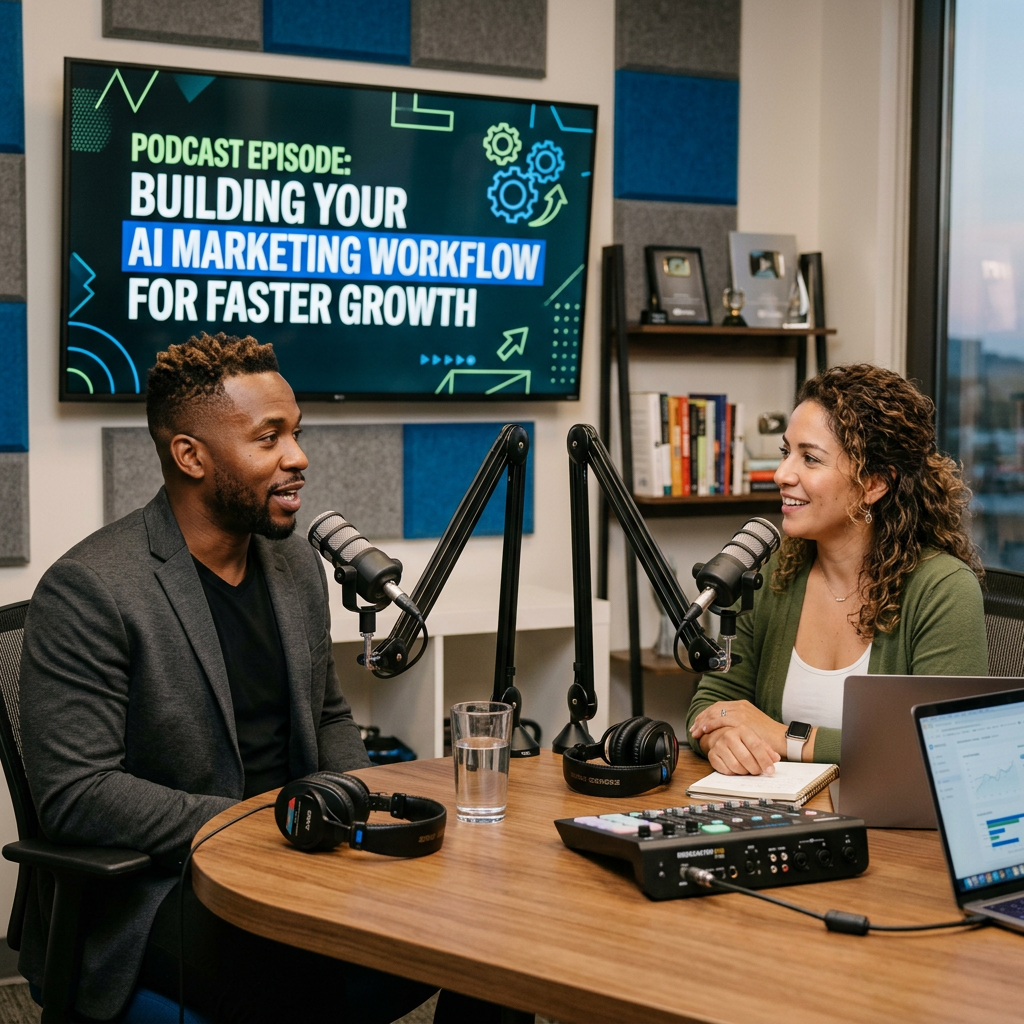
In this Podcast Episode: Traffic And AI Marketing, the episode compares email and social media as traffic channels, emphasizing that email lists are owned assets with more stable engagement, while social media is useful for discovery but vulnerable to declining organic reach and platform algorithm changes.
It also examines AI-assisted affiliate content workflows. AI can reduce time spent on research, drafting, and analysis, but marketers must provide specific instructions, verify claims, disclose accurately, and apply human judgment through product testing and editorial review.
Traffic And AI Marketing
Pip: If you’ve ever wondered whether your social following is an asset or just a very expensive pen pal arrangement you don’t own, rtateblogspot has been thinking about that too.
Mara: This episode covers two territories: how email and social media stack up as traffic engines, and how AI tools are changing the content workflow for affiliate marketers.
Pip: Let’s start with the audience growth question — email list versus social media.
Email or Social: What Actually Drives Consistent Traffic?
Mara: The core tension here is ownership. You can build a massive social following and still not control access to it.
Pip: The post puts it plainly: “Your list is an asset; your social following is a lease.”
Mara: That framing matters in practice. Email open rates run between 20 and 40 percent in many industries, with click-through rates of 2 to 10 percent — people who opted in tend to actually engage.
Pip: Social reach, meanwhile, has been quietly shrinking for years. Organic posts often land with only a fraction of your own followers.
Mara: The post isn’t anti-social, though. It positions social as the discovery engine — hashtags, shares, algorithmic feeds — and email as the relationship and revenue layer. The companion piece on effective email marketing reinforces that email is where the actual conversion work happens.
Pip: So social fills the funnel; email closes it.
Mara: And the stability argument is hard to ignore. Email as a channel has held its basic mechanics for decades. A platform’s algorithm can reshape your reach overnight.
Pip: Next up — what happens when AI enters the affiliate content workflow.
AI Prompts and the Affiliate Content Workflow
Mara: The question this segment addresses is practical: can AI actually accelerate affiliate content production without hollowing out the judgment that makes that content trustworthy?
Pip: The post’s answer is yes, conditionally — and it leans on a concrete data point to make the case: “Employees using AI save roughly 11 hours per week on research, drafting, and data-analysis tasks.”
Mara: What that means in practice is time redirected toward the work AI can’t do — firsthand product testing, accurate disclosures, editorial judgment on claims.
Pip: The post structures this around 25 prompts spanning research, SEO, product reviews, email sequences, short-form video scripts, and ad copy variations. The throughline is specificity: role, audience, product, tone, format, quality bar.
Mara: Vague prompts produce generic output. The post is explicit that you supply the niche, the product facts, the buyer stage — the tool handles speed, you handle accuracy. Every claim still needs checking against original sources before anything publishes.
Pip: There’s also a companion piece on AI agents for beginners, which broadens the picture — what these tools are and how someone new to them might actually get started.
Mara: Taken together, the argument is that AI compresses the production cycle, but human experience is still what makes affiliate content credible enough to convert.
Pip: Own your list, verify your AI output, and maybe don’t build your entire business on a platform that can reprioritize you out of existence next quarter.
Mara: The through-line across both topics is the same: tools change, but the underlying judgment about what your audience actually needs doesn’t.
Podcast Episode: Traffic And AI Marketing Insights





Leave a Reply