
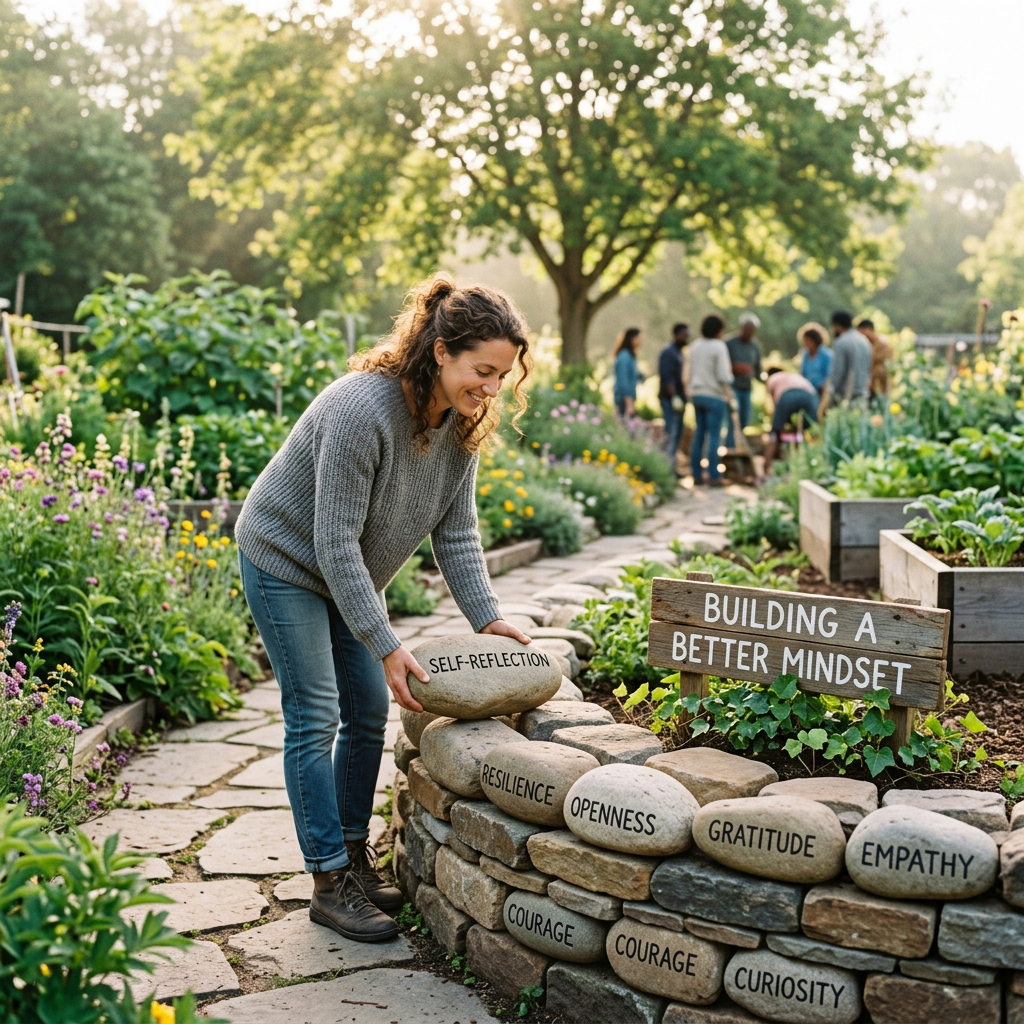
The episode examines self-awareness as a learnable skill and a foundation for personal growth. Building A Better Mindset is also explored through recognising emotions, physical reactions, habits, and defense mechanisms, while recommending journaling, energy tracking, self-assessment, and using feedback from others.
It also presents positive thinking as a practice rather than a fixed trait. Strategies include gratitude journaling, affirmations, reframing negative self-talk, positive visualization, and supportive social environments, with cited research linking optimism and resilience practices to improved well-being.
Pip: Welcome to the rtate blog recap — where we look at what rtateblogspot has been writing about, which this week turns out to be the entire interior of the human mind.
Mara: That’s actually a fair summary. We’re covering two territories today: building self-awareness as a foundation for growth, and the practical strategies behind cultivating a more positive mindset.
Pip: So: know yourself, then think better thoughts. Let’s start with the self-awareness side of things.
Knowing Yourself: The Foundation of Growth
Mara: The central question here is whether self-awareness is something you either have or you don’t — or whether it’s a skill anyone can build. The post on unlocking success and happiness through self-awareness comes down firmly on the side of skill.
Pip: And it reaches for a Tim Ferriss quote to make the stakes plain. The setup is emotional blind spots — the feelings we bury or rename — and then comes this: “You’re going to suffer either way. The only question is whether you do it in the darkness or in the light.”
Mara: That’s the core argument. Avoiding uncomfortable feelings doesn’t eliminate them; it just means the cost stays hidden. The post walks through how childhood experiences generate defense mechanisms — sarcasm, numbing, humor — that persist long after they stop being useful.
Pip: Renaming your anger “stress” is doing a lot of heavy lifting in that example.
Mara: It is, and that’s exactly the point. The post defines self-awareness as the ability to notice your feelings, physical sensations, reactions, habits, behaviors, and thoughts — and then act on what you actually see, not the story you’ve been telling yourself.
Building A Better Mindset for Personal Growth
Mara: The companion piece, “Unlock Your Self-Development: Proven Strategies,” extends this into daily practice — journaling feelings for at least thirty days, tracking energy levels to find peak performance windows, and a twelve-week self-assessment challenge that works through one life area per week.
Pip: Twelve weeks is a real commitment. Though apparently the alternative is feeling stuck indefinitely, so the math works out.
Mara: The post also frames self-knowledge as social, not just solitary. As Stephen Warley puts it, “The quest for self-knowledge is a fundamentally social endeavor” — meaning feedback from others is data, not a threat.
Pip: From knowing yourself to actively shaping how you think — that’s where the mindset work comes in.
Thinking Better: Strategies for a Positive Mindset
Pip: The question the positive thinking post is really answering is whether optimism is a personality trait or a practice — and it argues firmly for practice, with research attached.
Mara: The frame comes straight from Winston Churchill: “A pessimist sees the difficulty in every opportunity; an optimist sees the opportunity in every difficulty.” That’s the orienting idea — not cheerfulness, but a deliberate reframe toward what’s possible.
Mara: The practical stakes are significant. The post cites research showing optimistic individuals are one-third less likely to experience a heart attack, and links a positive mindset to lower risk of cancer, infections, and cardiovascular disease generally.
Building A Better Mindset for Personal Growth
Pip: So this isn’t self-help fluff — there’s a measurable physiological argument being made.
Mara: Right. The post covers several science-backed mechanisms: a study of anxiety patients found that visualizing positive outcomes reduced anxiety and improved restfulness. The Nun Study linked positive emotional expression in 1930s autobiographies to longer lifespans. The Penn Resilience Program has applied these techniques to school children and U.S. Army soldiers to build mental resilience and prevent PTSD.
Building A Better Mindset for Personal Growth
Mara: On the practical side, the strategies include daily gratitude journaling — three specific things per day — affirmations, reframing negative self-talk with a simple interruption phrase, and surrounding yourself with people and media that reinforce an upward pull rather than a downward one.
Pip: The companion piece, “Positive Mindset: The Key to Achieving Your Goals,” picks up the goal-setting angle — connecting this same mindset work directly to outcomes people are actually trying to reach.
Mara: Both posts land on the same underlying point: positivity compounds. Small daily habits — a gratitude note, a reframed thought, a morning routine — accumulate into a measurably different baseline over time.
Pip: What ties all of this together is that neither self-awareness nor positive thinking is presented as a fixed trait. Both are habits, built in small increments.
Mara: And both start with noticing — what you’re feeling, what you’re telling yourself, and whether that story is actually serving you.





Leave a Reply